
Decide what you want to change
Write down whether you want the original completely concealed, reworked into something you still recognize, or extended into a larger composition. Those are different briefs. If you only need temporary concealment, this permanent-design guide is not a makeup tutorial.
Choose a few generic styles and subjects you like, without asking to copy a particular artist's work. State how large and how dark you are comfortable going. If you want a very delicate replacement over dense black ink, make that conflict part of the consultation instead of hiding it in the brief.
Take a useful reference photo
Photograph the tattoo straight on in even light. Include surrounding skin and the full outline; avoid filters and glare. A close-up is useful for details, but a second wider image shows placement on the body.
Measure the existing tattoo and note any marks outside its main outline. For a curved area, bring additional views to your artist. One flat AI preview cannot show every side of a wrist, hand or shoulder.
- Full old tattoo visible, including faint edges
- Even lighting without filters
- Nearby body landmarks for placement
- Width and height measured separately
- Only your own photo, or an image you have permission to use
Map dark ink before choosing detail
Identify the strongest letters, solid patches and outlines. Compare designs whose darker elements occupy those areas. An open petal, pale animal face or gap between leaves may reveal the original ink even when the rest of the concept looks convincing.
Try more than one size and orientation. A slightly larger or rotated composition can give the artist a more useful starting point, but there is no universal enlargement multiplier that makes every cover-up work.
Compare concept and honest preview
Upload your photo to the Cover-Up Studio and choose a direction. The clean concept helps you assess style and composition. The honest preview simulates old-ink show-through so you can inspect where the old design may still read.
Treat the estimate as a planning signal, not a prediction of healed skin. Photo lighting, alignment and generated detail affect a simulation. It does not establish medical suitability, artist technique or the final healed outcome.
Take the brief to a cover-up artist
Bring the original photo, dimensions, selected concept and any concerns found in the honest preview. Ask for comparable healed work and have the artist explain where the old ink fits inside the new composition. Agree on size, scope and cost before booking.
If you are considering laser fading, speak with a dermatologist as well. If scars or changing skin are involved, obtain an appropriate skin assessment; the preview cannot provide that clearance. Follow the professionals' instructions about timing and care.
A concept to discuss, not a healed result
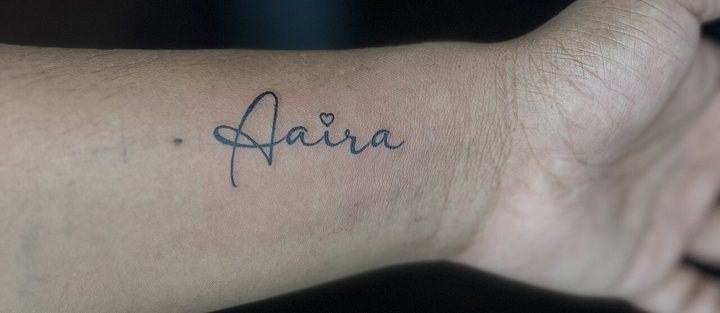
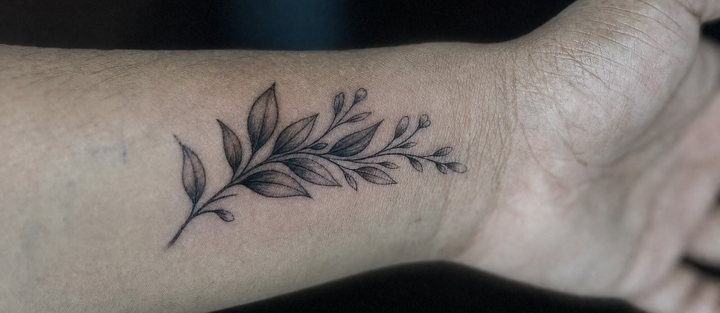
Generic name-tattoo research demonstration. Move the slider to compare the source photo with an AI concept; it does not show completed tattoo work, laser treatment or a medical outcome.
Source photograph: Saishna96 · CC BY-SA 4.0. Cropped research photograph; AI-edited concept and simulated show-through. These adaptations are shared under CC BY-SA 4.0.

See it on your skin first
Upload a photo — get 2 free concepts with an honest show-through check.
Try the cover-up generatorFAQ
Can I use any tattoo design as a cover-up?
A design made for blank skin may place open or light areas over old ink. A cover-up artist needs to adapt its position, dark values and size to your existing tattoo.
Does an honest preview guarantee coverage?
No. It is a simulation of old-ink show-through on a photograph, not a healed-result prediction or a guarantee that an artist can tattoo the concept as shown.
Should I book from the AI image alone?
Use it to explain your preferences. Ask an experienced artist to assess the actual tattoo and adapt the drawing before committing to the work.